Will AI replace UX designers? AI changes how we design, and it makes why we design matter more.

AI can generate a screen in seconds. It cannot sit with a frustrated user, notice what they didn't say, align a room of stakeholders, or decide what is ethical to ship. Those are UX skills — and every AI product being built today needs them.

Will AI replace UX designers? Myths vs reality

What people fear about AI and UX designers, and what's actually happening.

What people fearWhat's actually happening
"AI will design everything."AI produces drafts. Someone still has to decide which draft solves the right problem.
"Junior UX roles will disappear."Routine tasks shrink; designers who use AI well deliver more and grow faster.
"Research is no longer needed."AI can summarise data, but only real users reveal real needs. Synthetic users are a starting point, not the truth.
"Tools matter more than skills."Tools change every few months. Problem framing, empathy and critique last a career.
"UX is a saturated field."Every AI product — chatbots, copilots, agents — creates new UX problems: trust, transparency, errors, control.

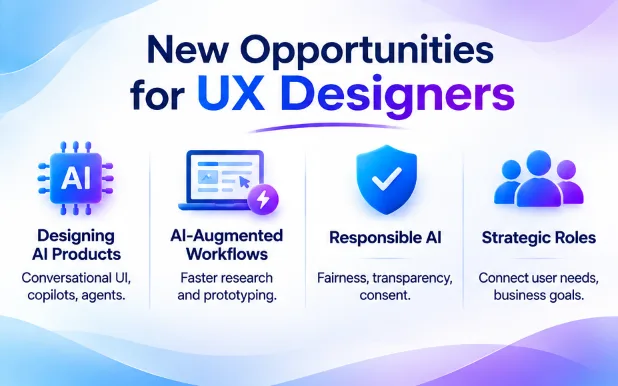
New opportunities for UX designers

Designing AI products

Conversational UI, copilots, agents and AI-driven features.

AI-augmented workflows

Faster research synthesis, ideation and prototyping.

Responsible AI

Fairness, transparency, consent and human oversight.

Strategic roles

Designers who connect user needs, business goals and AI capability.

What AI does well — and what it can't

None of what AI does is the job. The job is the decision.

What AI can do

  • Generate layouts
  • Draft personas and flows
  • Summarise research notes
  • Produce components
  • Critique a flow on request

What the job is

  • Choosing which output is right
  • Proving it with evidence
  • Putting your name to the decision when it ships

Why beginners have an advantage right now

Nothing to unlearn

No habits from the old, production-heavy workflow.

Learn both at once

You learn judgement and AI tools at the same time.

Evidence of thinking

You build evidence of your thinking, not just screens.

Faster to useful work

You reach useful output faster than earlier learners could.

Where a UX career leads

A junior UX job is one destination, not the only one. The same skills open:

  • Product design roles
  • Freelance client work
  • Agency and studio work
  • Front-end work with real ownership
  • Building your own product

Industries hiring UX

SaaSFinTechHealthcareE-CommerceEdTechGovernmentConsultingAgenciesStartups

Will AI replace UX designers? The short answer

Will AI replace UX designers? Not the ones who understand people. AI is good at drafts: first wireframes, summaries, transcripts and variations. It is not good at sitting with a frustrated user, noticing what they did not say, aligning stakeholders or deciding what is ethical to ship. Those judgement calls are the core of the job.

The better question

So the real question is not whether AI will replace UX designers, but which designers will use AI well. Designers who combine human-centred thinking with AI tools work faster and make better decisions. That combination is what our training teaches, from the first module to the final design defence.

How AI is changing UX work

AI is taking over repetitive tasks such as first-draft wireframes, transcripts and research summaries. That frees designers to spend more time on understanding people, framing the right problem and defending their decisions with evidence. New roles are also appearing, such as designing AI products, conversation design and AI-assisted research, and each one still needs a human who understands users.

What to do next

If you are new to the field, start with the basics. The Nielsen Norman Group's definition of user experience explains what the work involves. Then see the Training programs, read the UX course FAQ, or book a free guidance call to ask whether AI should change your plans for a UX career.
Will AI replace UX designers? A human hand and a robot hand reach toward each other under the words UX + AI

AI in a real UX project: where it helps and where you decide

The easiest way to see the split between AI and the designer is to follow one project from start to finish. This is how it plays out on the guided case study in our course.

Research: AI summarises, you decide what matters

After user interviews, an AI assistant can transcribe the calls and group similar comments in minutes. What it cannot do is notice the pause before a user answered, or judge which complaint is a real barrier and which is a passing annoyance. You still choose which findings shape the design.

Ideation: AI widens the options, you choose the direction

Ask an AI tool for ten layouts of a checkout screen and you get ten fast starting points. Picking the one that fits your users, your business goal and your technical limits is a human call, and so is explaining why.

Testing: AI flags risks, you verify them

AI can review a flow and point out possible usability problems. Some will be real and some will be noise. A designer checks each one with real users before changing the design, which is why our course treats AI as a critic to question, never an authority to obey.

Presenting: you defend the decision

Stakeholders do not ask the AI why a button moved. They ask you. Defending a choice with evidence is the skill that stays valuable, and it is the focus of the final design defence in our UX design training.

Infographic of UX career opportunities in the AI era

Will AI replace UX designers? See how the curriculum prepares you

10 modules that follow one guided UX case study from problem to design defence, with AI used at every step.